Melons Australia's CEO Update


We're doing things a little different this month, presenting our updates in video format. We would love your feedback on this.

We appreciate that some in our sector are doing it very tough, we are here to help. So please, if there is anything that the Melons Australia team can support or assist you with feel free to reach out.

Johnathon Davey - CEO

E: ceo@melonsaustralia.org.au

P: +61 407 032 023

www.melonsaustralia.org.au

New Project: Evaluating Mechanical Harvesting Solutions for the Australian Melon Industry


Melons Australia has recently been selected to deliver a new 12‑month project designed to bring industry stakeholders together to assess mechanical harvesting options for the Australian melon industry. The project responds to ongoing labour challenges and increasing interest from growers in the potential role of automation to support sustainable production.

In recent industry consultations, Melons Australia has heard of strong grower interest for field demonstrations of mechanical harvesting systems. This project has been structured to meet that demand, providing growers with direct exposure to emerging technologies and practical insights into their suitability for Australian growing systems. We will seek to validate, adapt and consider options for the future deployment of mechanical harvesting solutions through a collaborative program in Australia. Key activities will include international field trials, in‑country grower engagement, and targeted technology evaluation. Together, these components are intended to support informed decision‑making by growers and the broader supply chain.

Project outputs will include a documented global scan of available mechanical harvesting technologies, with a specific focus on supporting grower evaluation of the TerraForce AI mechanical melon harvester. As part of this assessment, the project is now progressing toward Phase 2, which will involve a validation tour to the United States in late July 2026. This tour will provide participating Australian growers with the opportunity to see the harvester operating under commercial conditions, engage directly with U.S. growers using the technology, and explore considerations around potential importation and adoption within Australia.

The final stage of the project will address the practical logistics of importing either a full demonstration machine or selected system components, such as robotic arms. This stage will culminate in an industry update and planned technology showcase at the Melon Industry Conference, to be held in Townsville and Ayr from 7–9 October 2026.

Melons Australia is now seeking expressions of interest from growers who wish to be considered for participation in the U.S. Mechanical Harvest immersion tour scheduled for late July 2026. For further discussion about this program of work, please contact Johnathon, CEO of Melons Australia - ceo@melonsaustralia.org.au

Cosmetic Downgrade Questionnaire


End Food Waste Australia have put together a short questionnaire to collect more information on what cosmetic specifications are causing downgrades of fresh produce in horticulture.

You can complete the survey here:

https://bit.ly/CosmeticDowngrade

Food Safe Project Update

Free Horticulture Workshops across Australia – AGI Engage Session Now Open


Australian-Grown Innovation (AGI) is a national innovation capability program for horticulture, helping growers, startups, and industry participants turn ideas into practical, commercially viable solutions.

The program runs across three phases — Engage, Incubate, and Build — supporting participants from early-stage ideas through to real-world testing and industry collaboration. Along the way, participants gain access to structured workshops, practical tools, and guidance from experienced mentors and industry experts.

Below are the last remaining engage sessions. These sessions are hands-on and designed to help you explore your idea, understand real industry problems, and see how AGI can support you further.

Upcoming Engage Sessions:
• Morwell, VIC (7 May): https://luma.com/il3awgbz
• Online (19 May): https://luma.com/0rdhlleo
• Online (21 May): https://luma.com/ocwr5m26

2027 Nuffield Scholarship Applications


Applications are now open for the 2027 Nuffield Scholarships.

Nuffield develops farmers with the global perspective, insight and confidence to influence Australian agriculture.

This scholarship is not about having the perfect project.

It is about backing people with intent. People prepared to challenge assumptions, think beyond their own operation and contribute to the future of their industry.

If you believe leadership in agriculture is a responsibility, not a title, this may be your next step.

Applications close 8 May 2026.


Life doesn’t slow down—and neither do the pressures that come with it.

That’s where Mind Your Melon comes in. This new wellbeing initiative is all about keeping your mental health in good shape, with practical tools you can actually use day to day.

You’ll hear from psychologists at Healthy Minds and join relaxed check-in sessions—real conversations, no pressure—where you can pick up simple ways to handle stress, spot when things aren’t quite right, and look after yourself and your mates.

It’s all about staying ahead of the curve, not just reacting when things get tough—and it works alongside existing support like EAP.

Jump in when you can (12–1 ACST):
7 May, 4 June, 18 June, 23 June, 6 August, 3 September, 17 September, 8 October, 19 November, 3 December.

Curious? Check it out: https://animaco.com.au/what-we-offer/mind-your-melon/or reach out at NABS@aff.gov.au

Rabobank: Global fertiliser market facing prolonged period of strain from Middle East disruption


The global fertiliser market faces prolonged tight supply, sharply higher prices and weak affordability due to escalating conflict in the Middle East and the effective closure of the Strait of Hormuz, according to Rabobank’s Semi-annual Fertiliser Outlook released 21 April 2026.

Nitrogen and phosphate prices have surged far faster than grain prices, pushing RaboResearch’s fertiliser affordability index deep into negative territory for most of 2026. This is expected to trigger widespread “demand destruction” as farmers cut application rates or switch to less fertiliser-intensive crops.

Even if tensions ease, normalisation will be slow, with increased risks to global crop production and food prices.

In Australia, the impact is acute. Urea prices have skyrocketed 94% year-to-date (in AUD), while DAP has risen 11%. Despite a stronger Australian dollar, high fertiliser costs combined with weak grain prices are squeezing margins. Rabobank expects farmers to shift away from wheat toward barley and canola, resulting in a pronounced decline in total fertiliser use in 2026.

Fertiliser Supply Working Group Information


The below insight has been provided to Melons Australia from the National Farmers’ Federation, of which we are a member, in representing the interests of the Australian agriculture industry in engagement with Government and other stakeholders. All information received from growers regarding the current Middle East conflict and its impacts have been relayed to the NFF through the NFF Hort Council.

Key facts
  • Fertiliser consignments are continuing to enter Australia, and work is underway with industry to support fertiliser entering through a broader range of supply pathways.
    • These consignments will continue to be prioritised for clearance at the border.
     
  • The amount of urea landed to date is in line with the average of the last three years at the same point in time. Maintaining reliable supply for top dressing and other seasonal requirements remains essential and is a key focus of government and industry planning.
  • Ongoing demand will ultimately depend on seasonal conditions and production decisions being made in the context of significant price uncertainty.
    • Based on production forecasts, it is estimated Australia requires approximately 2.3 million tonnes of agriculture-grade urea for the growing season. In previous years, the previous peak in urea fertiliser imports have occurred between April and July.
    • Since November, around 1.3 million tonnes of urea have been imported into Australia, which is slightly ahead in comparison to recent years. Other drivers such as climate and higher fertiliser prices are expected to impact overall demand.
    • The recent deal between Incitec Pivot Fertilisers and PT Pupuk Indonesia for 250,000 of urea is expected to cover at least 20% of the remaining annual demand. DAFF, DISR, DFAT and our broader international network are working closely together to support importers by addressing the remaining forecasted total demand for the 2026 calendar year.
     
  • It is also understand that other specialty fertilisers such as phosphorus and sulphur are being impacted, by both supply and price.
 

Action is being taken
  • Government has acted fast to secure urea supplies for Australia across a number of fronts. Close collaboration with industry is a key pillar of this response.
  • The Fertiliser Supply Working Group allows for the sharing of industry insights, supply challenges and priorities between industry and government to inform timely and proportionate policy responses as market conditions evolve.
  • Government has been working with industry to agree arrangements for underwriting of fertiliser shipments by Export Finance Australia (EFA).
    • Agreement to initial frameworks with CSBP and Incitec Pivot were announced on 22 April, and EFA will continue to work with additional suppliers to reach agreements in line with the approach taken for fuel suppliers.
    • The support mechanism is not a subsidy or grant, but it involves price risk support to protect importers from extreme price volatility. This will support Australian importers to be first in line to secure international cargoes, as they become available to secure urea supplies for Australian producers.
     
  • The government announced $1 billion through the National Reconstruction Fund’s Economic Resilience Program for zero‑interest finance for critical supply chains, including fertiliser, to support businesses impacted by Middle East disruptions.
  • The government has also updated internal procedures to streamline biosecurity clearances of fertiliser shipments, while maintaining strong safeguards, to ensure fertiliser can move from ships to producers as efficiently as possible.
  • Support domestic fertiliser production through the Perdaman Urea Project in Western Australia
 

Melon Quality Project Update

Hort Innovation Quarterly 2026 Ag Chem Update


The quarterly 2026 Ag-Chem Update highlights key regulatory developments impacting chemical access, compliance, and export markets for Australian horticulture. Domestically, the APVMA is progressing several major chemical reviews (including paraquat/diquat, fipronil, and neonicotinoids), while introducing measures to improve efficiency—such as faster pathways for low-risk products, increased focus on minor-use permits, and updated guidance to streamline product registrations using reference data.

Several changes to maximum residue limits (MRLs), product registrations, and permits were announced, alongside updates to withholding periods and new uses for certain chemicals. Internationally, significant MRL changes and regulatory shifts are underway across key markets including the EU, Asia, and Codex, with some tightening limits or revoking approvals for certain actives.

International Day of Plant Health: Plant biosecurity for food security


The International Day of Plant Health (12 May) is a United Nations observance that raises awareness of the critical role plant health plays in food security, environmental protection and economic growth. The 2026 theme, Plant biosecurity for food security, highlights the importance of preventing pests and diseases to protect crops and support a zero-hunger world.

Pests and diseases destroy up to 40% of global crops each year, with increasing trade and travel raising the risk of spread.

Learn more about International Day of Plant Health

Protecting plant health is essential for maintaining agricultural productivity, safeguarding ecosystems and supporting global food supply.

For Australia, strong biosecurity systems are vital to protect agriculture, maintain export markets and prevent exotic pests from establishing. Protecting plant health is a shared responsibility—governments, industry and individuals all play a role. Simple actions, such as sourcing plants responsibly and reporting unusual pests early, can help safeguard food security for the future.

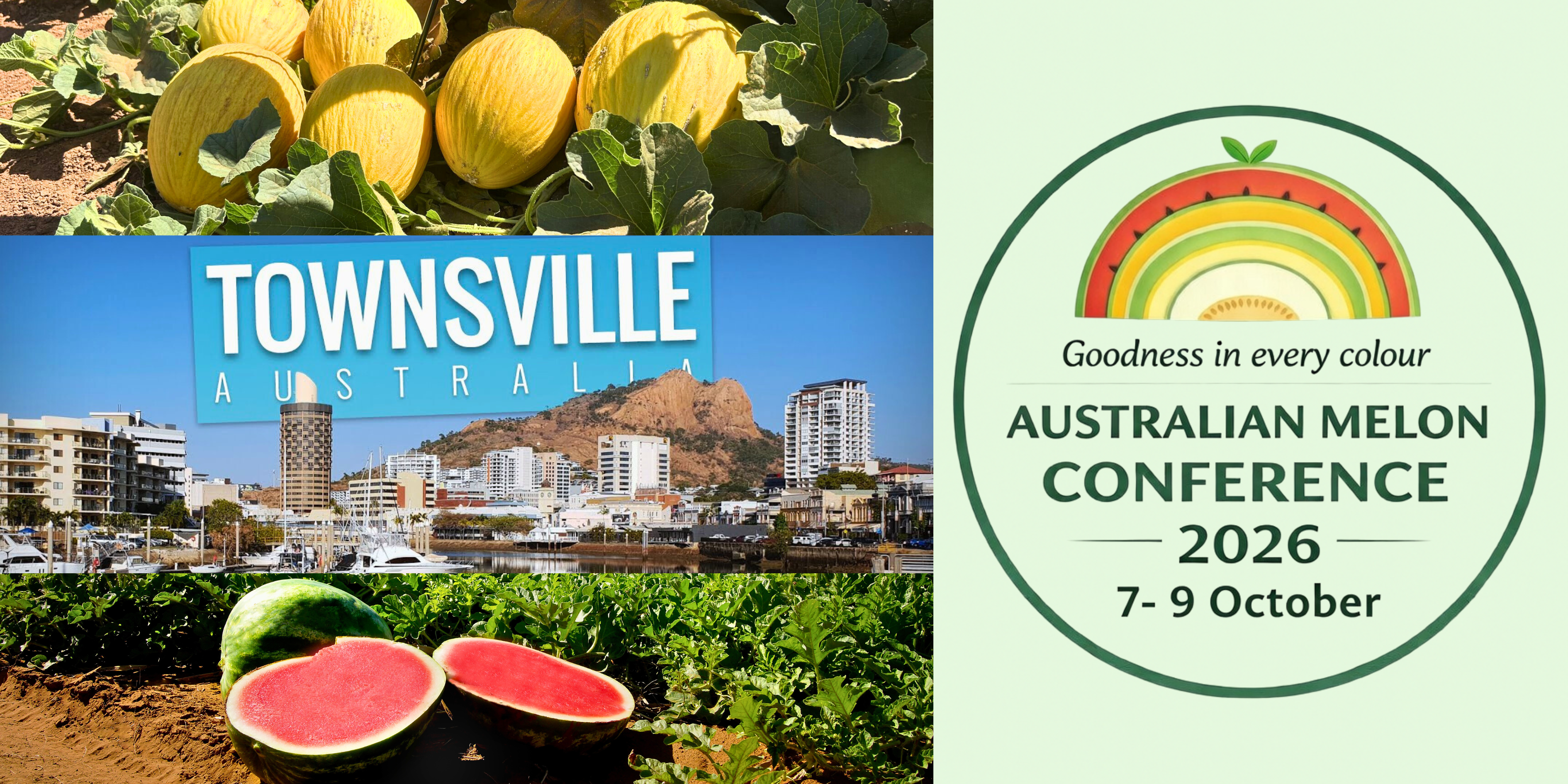
Melons Australia Conference 2026


We’re thrilled to bring you the Australian Melon Conference 2026, happening 7-9 October 2026 in Townsville, Queensland!

We have chosen Townsville as the location to host our melon conference, with a field day in Ayr (just 80-90 km south in the Burdekin region). As the gateway to North Queensland—one of Australia’s leading melon production areas for rockmelons, watermelons, honeydews, and specialty varieties—Townsville provides direct access to active growing operations. This allows delegates to combine valuable conference sessions on research, innovation, marketing, and trends with practical, hands-on experiences such as variety trials and farm demonstrations in Ayr

Our three-day event will include:
  • An engaging field day showcasing new melon varieties
  • 2 day conference, R&D and workshop session
  • A memorable Gala Dinner to celebrate successes and make valuable connections
 

Further information and early bird tickets coming soon!

Melons Australia in Griffith, Barmera and Mildura


Join us in both Mildura and Barmera in May for the Australian Melons Roadshow. We will also be heading to Griffith for farm visits and hosting a dinner for growers to attend.

If you'd like any on farm engagement/support during this time, we would be happy to come and visit you, please contact Jo to confirm (biosecurity@melonsaustralia.org.au).

The two separate roadshow afternoons will include a number of speakers providing updates on the various Melon fund projects. We will also have time for questions, networking and light refreshments.

Speakers to include: Industry Update Melons Australia CEO - Johnathon Davey, Biosecurity Update: Melons Australia Biosecurity Officer - Joanna Embry, Food Safety: DPI NSW - SP Singh, Quality Improvement: Delytics - Mark Loeffen, Hort Innovation Update: Hort Innovation - Mark Spees, Soil Wealth Project Update: AHR - Brad Giggins, Gummy stem blight and anthracnose in melons: Agreco Australia - Cherie Gambley.


Griffith Grower Dinner:


Date: 27th May

Register your interest now by emailing biosecurity@melonsaustralia.org.au


Mildura Event Details:


Date: 28th May

Arrive: 3.45pm for a 4pm start

Finish: 6pm with drinks and light refreshments offered

Location: Mildura Golf Resort, Twelfth Street Extension, Mildura, 3502, Australia


Barmera Event Details:


Date: 29th May

Arrive: 3.45pm for a 4pm start

Finish: 6pm with drinks and light refreshments offered

Location: Barmera Hotel Motel, 31/31 Barwell Ave, Barmera SA 5345


REGISTER BY RESPONDING TO THIS EMAIL



Contact:

Melons Australia

E: ceo@melonsaustralia.org.au

Copyright © 2026 Melons Australia

All rights reserved.

unsubscribe from this list

Langauge

Original text
Rate this translation
Your feedback will be used to help improve Google Translate